This differs from inductive learning in that the domain theory implies the new knowledge. It is sometimes called deductive learning or analytic learning.
Target Concept: cup(C) :- premise(C).
Domain Theory:
   cup(X) :- liftable(X),
	     holds_liquid(X).
   holds_liquid(Z) :- part(Z,W),
		      concave(W),
		      points_up(W).
   liftable(X) :- light(X), part(Y,handle).
   light(X) :- small(X).
   light(X) :- made_of(X,feathers).
Note that the domain theory includes the knowledge needed to determine when something is a cup. We want an explicit rule that specifies when something is a cup.
Training Example: An Instance of a Cup
  cup(obj1)          small(obj1)       part(obj1,handle)
  owns(bob,obj1)                       part(obj1,bottom)
				       part(obj1,bowl)
  points_up(bowl)
  concave(bowl)
  color(obj1,red)
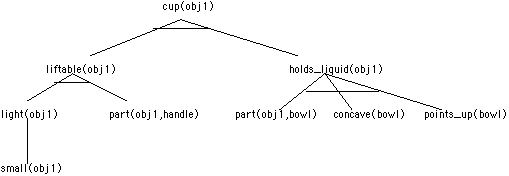
Proof (or Explanation): Use the domain theory to prove that the instance is a cup. Then generalize the proof.
First: Prove that obj1 is a cup.
Next: Generalize the proof to: X is a cup. To
generalize, we generalize all constants that depend solely on
the training example. So bowl and obj1 are
constants found in the training example but not in the domain
thoery.

Next: Add the new chunk of knowledge to the domain theory.
   cup(X) :- small(X),
             part(X,handle),
             part(X,W),
             concave(W),
             points_up(W).
Note that none of the irrelevant information in the training example has made it into the proof or into the new knowledge.
The new rule can be used to identify a cup.