


Most personal computers contain software that enables them to be connected to networks of various sizes. Networks allow many individual users to share costly computer resources, such as a high-speed printer or a large disk drive or file server that is used to store and distribute both data and programs to the computers on the network.
File servers are just one example of client/server computing , a computing model made possible by networks. According to this model, certain computers on the network are set up as servers, which provide certain well-defined services to client computers. For example, one computer in a network may be set up as the mail server with the responsibility of sending, receiving and storing mail for all users on the network. Users may use client application software, such as Eudora or Pine, to access their mail on the server. Similarly, another server may be set up as a Web server with the responsibility of storing Web pages for all the users on the network. Users can run Web browsers, another type of client software, to access Web pages on the server. Java is particularly well suited for these types of networked or distributed applications, where part of the application software resides on a server and part resides on the client computer.
Networks can range in size from Local Area Networks (LANs), which connect computers and peripherals over a relatively small area, such as within a lab or a building, through Wide Area Networks (WANs), which can span large geographic areas, such as cities and nations.
The Internet (with a capital I) is a network of networks whose geographical area covers the entire globe. The World Wide Web (WWW ) is another example of distributed, client/server computing. The WWW is not a separate physical network. Rather it is a subset of the Internet that uses the HyperText Transfer Protocol (HTTP ). A protocol is a set of rules and conventions that govern how communication takes place between two computers. HTTP is a multimedia protocol. It supports the transmission of text, graphics, sound, and other forms of information. Certain computers within a network run special software that enables them to play the role of HTTP servers. They store Web documents and are capable of handling requests for documents from client browser applications. The servers and clients can be located anywhere on the Internet.
The documents stored on Web servers are encoded in a special text-based language known as HyperText Markup Language, or HTML . Web browsers, such as Netscape's Navigator and Microsoft's Internet Explorer, are designed to interpret documents coded in this language. The language itself is very simple. Its basic elements are known as tags, which consist of certain keywords or other text contained within angle brackets, < and >. For example, if you wanted to italicize a chunk of text on a Web page you would enclose it between the <I> and </I> tags. Thus, the following HTML code
<i>Italic font</i> can be used for <i>emphasis</i>.
would be displayed as
by the Web browser.
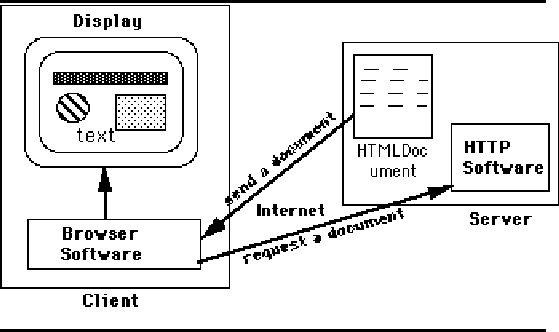
When you use a Web browser to surf the Internet, you repeatedly instruct your browser to go to a certain location and retrieve a page that is encoded in HTML. For example, if you typed the following URL (Uniform Resource Locator)
http://troy.trincoll.edu/~jjj/index.html
into your browser, the browser would send a message to the
Web server troy located in the trincoll.edu domain -- the
trincoll portion of this address specifies Trinity College and
the edu portion specifies the education domain of the Internet
-- requesting that the document named index.html in the
jjj home directory be retrieved and sent back to your computer
(Fig ![[*]](../cross_ref_motif.gif) ). The beauty of the Web is that it is possible
to embed text, sound, video, and graphics within an HTML document,
making it possible to download a wide range of multimedia resources
through this (relatively) simple mechanism.
). The beauty of the Web is that it is possible
to embed text, sound, video, and graphics within an HTML document,
making it possible to download a wide range of multimedia resources
through this (relatively) simple mechanism.
 |
The Web has enormous potential to change business, entertainment, commerce, and education. The fact that it is now possible to download computer games and other application software from the Web may completely change the way new software is purchased and distributed. Similarly, as noted earlier, many businesses have begun to organize their information systems into intranets -- private networks that have implemented the HTTP protocol. Currently, one of the big areas of development on the Web is commerce. As soon as consumers gain confidence that credit card information can be securely transmitted over the Web (as it can over a telephone), the Web will be poised to explode as a marketing medium as powerful, perhaps, as television is today. Because Java has been designed to support secure, distributed, networked applications, it is ideally suited to be used as the language for these types of applications.